Golfinity
Golfinity — 90-Day Trajectory
Presentation Deck Label: Client PresentationTracked across ChatGPT, Perplexity, Claude, Google AI Overviews, and other AI search and answer tools. Verified via multi-engine prompt sampling and public record attribution. Click any data point to inspect exact AI prompt & response evidence.
Local search behavior has changed shape. Someone looking for indoor golf in Austin used to type three words into Google and scan a map pack. Increasingly they ask an assistant a full question — where can I practice indoors near me, which place has Trackman, is there somewhere with bays I can book for a couple of hours after work — and receive a synthesized answer naming one or two venues.
That shift punishes a specific kind of business: one whose real-world offering is far more impressive than its machine-readable footprint. Golfinity has 20,000 square feet, eighteen-plus simulator bays, Trackman 4 and Foresight GCQuad, 3D swing analysis, and Club Champion fitting on site. Very little of that specificity was structured in a form a model could retrieve and repeat.
Local AEO also has an unusually direct feedback loop. There is a finite set of ways to ask for indoor golf in Austin, which means the prompt set is tractable, the competitor set is knowable, and share of answer can be measured precisely rather than estimated.
A second, sharper problem arrived with the calendar. The club's fourth-anniversary member celebration is a fixed, dated, free-admission event with a named PGA professional attached to it — precisely the kind of thing people ask an assistant about in the week beforehand. Inspecting the site's raw structured data returned LocalBusiness, PostalAddress and OpeningHoursSpecification nodes and nothing else. There was no Event object, which means that to any retrieval system the event did not exist.
Which stages applied, and what they produced.
Map
Built a tracked prompt set of conversational local queries — near-me phrasing, equipment-specific asks, use-case asks like corporate events and lessons — and baselined which venues answer engines currently name.
Ground
LocalBusiness structured data covering location, hours, amenities, equipment and membership tiers, plus Google Business Profile alignment so the same facts appear consistently everywhere a model might read them.
Structure
Content restructured around the actual questions — what equipment is available, what membership costs, whether bays can be booked hourly, whether it suits corporate events — each answerable in isolation.
Announce
The fourth-anniversary celebration specified as a retrievable object rather than a graphic: an Event node with dated start and end times, the venue as a resolvable Place, an absolute image URL, free admission stated through both the accessibility flag and a zero-price Offer, and a Person node for the CEO as organizer.
Corroborate
Review velocity, local citation consistency, and an earned-media program: a release written so a local desk can lift a paragraph without rewriting, pitched to named Austin outlets, with the structured event page as the thing being pitched.
Stage names refer to The Citation Engine
Specificity is the whole game in local AEO. A model choosing between venues has to distinguish them, and it can only distinguish on facts it can retrieve. Trackman 4 and Foresight GCQuad are exactly the kind of retrievable specifics that let an engine answer a narrow question confidently — which is why the equipment inventory matters more than any adjective about atmosphere.
The membership structure is similarly useful. Published tiers at $99, $199 and $299 per month let an engine answer price questions directly instead of hedging, and questions about cost are among the highest-intent prompts in the set.
The anniversary event is where the local and media halves of the engagement meet. An event is the most perishable content a venue publishes and among the most likely to be asked about conversationally, and the near-universal convention is to announce it as an image on social media — legible to a person, illegible to a retrieval system, which sees no start time, no location object and no way to tell whether the date has passed. Publishing the same announcement as an Event node with a resolvable venue and a named organizer converts it from a sentence into an object an engine can retrieve and repeat.
Structure alone would not be sufficient, which is the argument for running earned media inside the same engagement rather than beside it. An engine weighing whether to name an event is weighing a first-party claim about your own significance, and that is exactly the class of assertion retrieval systems discount. One dated third-party mention naming the event, the venue and the date establishes it independently of the party promoting it. Commissioning the markup and the outreach separately reliably produces one without the other.
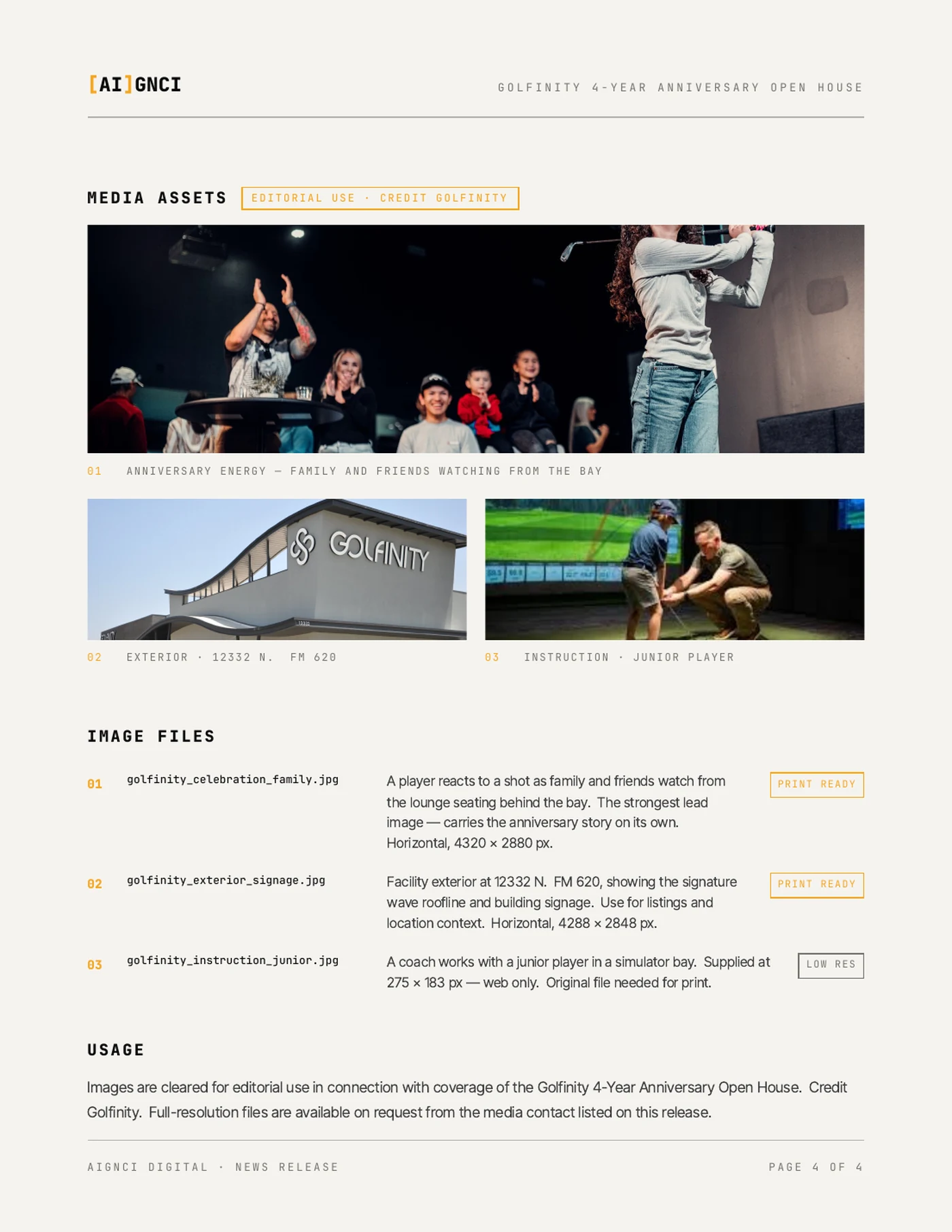
The media kit shipped in August 2026 and shows what the corroboration half requires in practice. Four pages: the announcement with day, date, hours and street address inside the first sentence; a named quote from Aaron Bergman, PGA, as Founder and CEO rather than an unattributed spokesperson; the seven anniversary activities as table rows rather than a comma-separated list, so a subeditor and a language model can both pull a single item cleanly; crew logistics stated down to a reserved lit bay, private lot parking and load-in help; and an asset manifest giving filename, pixel dimensions, editorial clearance and print-readiness per image, including one file flagged web-only so a picture desk is not left to discover that at deadline.
One editorial decision in the release is worth naming because it cost nothing and buys a great deal. The venue is described as one of the country's largest indoor golf performance clubs rather than the largest. A qualified superlative is defensible to an editor and safe for a model to repeat; a bare one invites both to discount the source. Superlatives are where releases lose credibility, and the fix is a single clause.
Two housekeeping items surfaced during the audit and are worth naming because they are common: zero-value statistic counters on the homepage, and on-site testimonials attributed by initials rather than full names. Both are now corrected on the live site — the facility figures render as real numbers and read consistently with the Business Profile. We mention them because catching this class of defect, and confirming the fix rather than assuming it, is what a retainer is actually for.
- Engagement type
- Local AEO retainer + earned media, no rebuild
- Schema
- LocalBusiness · Service · FAQPage · Event · Person
- Tracked prompt set
- Conversational Austin-local queries
- Surfaces aligned
- Site · Google Business Profile · local citations · press
- Media deliverable
- Four-page kit: release, activity tables, media logistics, asset manifest
Local AEO baseline established, the anniversary event specified for structured publication, and the media kit issued in August 2026. Coverage secured and measured share-of-answer movement will be published after the August 29 date with figures, rather than projected here.
Continue throughthe evidence.
Tell us what you are building.
If the question is about discovery, reputation, a new site, or a market move, send the context. AIGNCI will tell you whether an Audit, a build, or a more focused engagement is the right starting point.