Mammoth China Outbound
Mammoth China Outbound — 90-Day Trajectory
Presentation Deck Label: Client PresentationTracked across ChatGPT, Perplexity, Claude, Google AI Overviews, and other AI search and answer tools. Verified via multi-engine prompt sampling and public record attribution. Click any data point to inspect exact AI prompt & response evidence.
This was not a marketing site. It was a fundraise carried on a domain — and the argument it had to make is genuinely difficult: that a gap exists between Chinese advertiser demand and global premium media supply, that four separate constituencies are blocked by the same missing infrastructure, and that this specific team is the one able to build it.
Complex investment theses fail on the web for a predictable reason. Written as prose they are unreadable; broken into bullets they lose the causal chain that makes them persuasive. An investor needs to move from market, to problem, to timing, to positioning, to proof, to economics, to the ask — in that order, without losing the thread.
The team credentials were extraordinary and needed handling with restraint: a former APAC CEO of Wavemaker who built a $350M business with 3,000 people, a former Wavemaker China CEO who took Spotify's China export business from zero to double-digit millions in six months, a former JD.com Retail GM who drove 23B RMB in GMV in six months, and a US co-founder with C-suite history at Disney, Lionsgate and Warner Music across five exits. Overstated, that reads as puffery. Understated, it is the entire investment case.
I ran media agencies in Asia for twenty years, so I've sat through a lot of website proposals. Chuck was the first person who asked how the argument would be retrieved rather than how the page would look. He sequenced our thesis the way an investor actually reads one — market, problem, why now, positioning, proof, economics, the ask — and then made every figure traceable to a named publication with a date. There's a page where each number sits beside its source, alongside an explicit statement of the four things about this market that are not reliably known, including our own $60B estimate labelled as an estimate. In a cross-border category where confident numbers are the norm precisely because nobody can check them, publishing our own uncertainty was the most commercially useful decision he made. It's why the site survives due diligence.
Which stages applied, and what they produced.
Structure
Sequenced the entire thesis as a linear argument — market, problem, why now, positioning, three-legged proof, business model, economics, the ask — so each section earns the next rather than restating it.
Ground
Every market claim carries its figure and its source, including Dentsu's projection that algorithmic buying reaches roughly 79% of spend by 2027. In investor contexts, an unsourced number is worse than no number.
Corroborate
Team credentials presented as specific, checkable achievements rather than adjectives — named companies, named scale, named outcomes.
Stage names refer to The Citation Engine
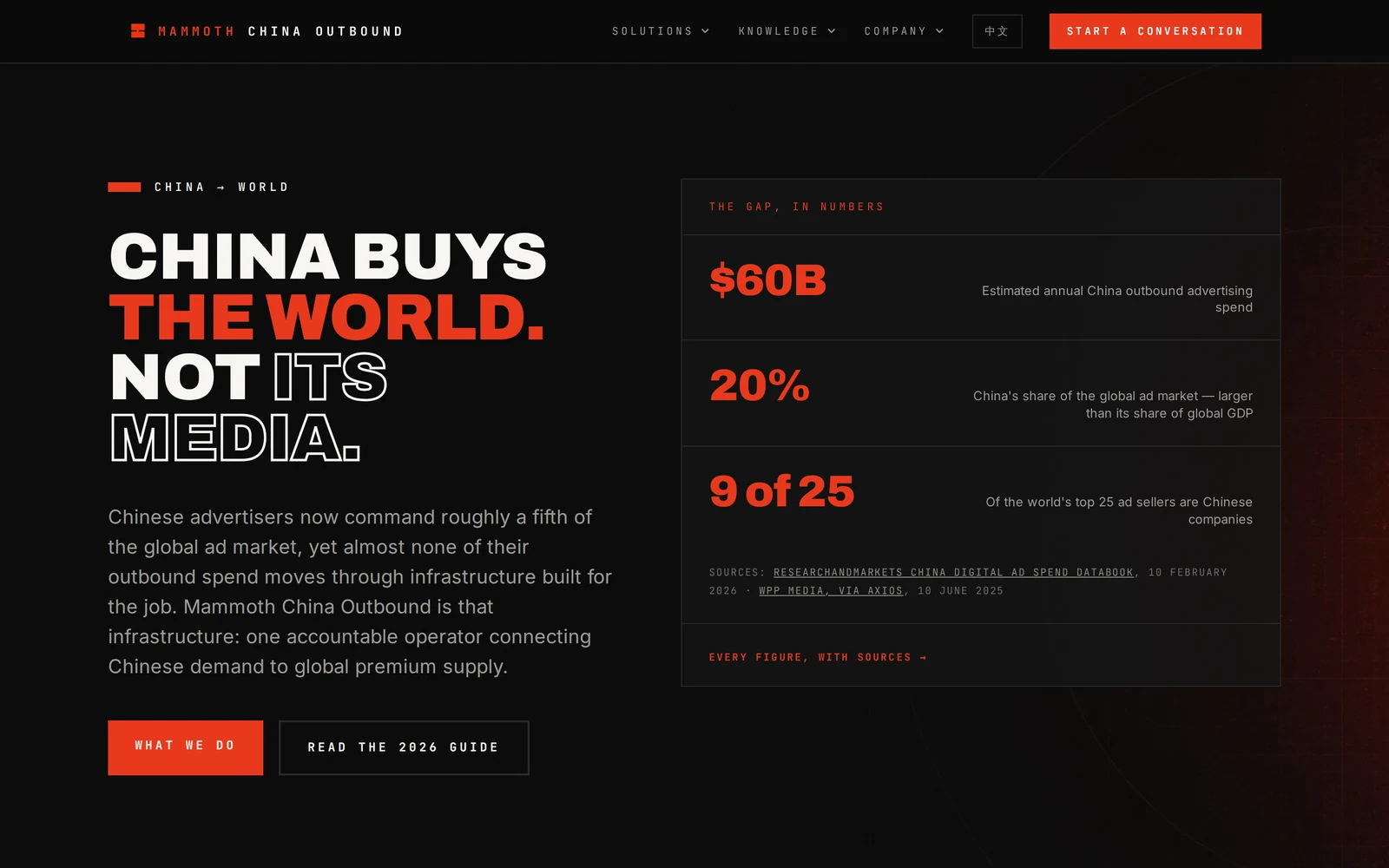
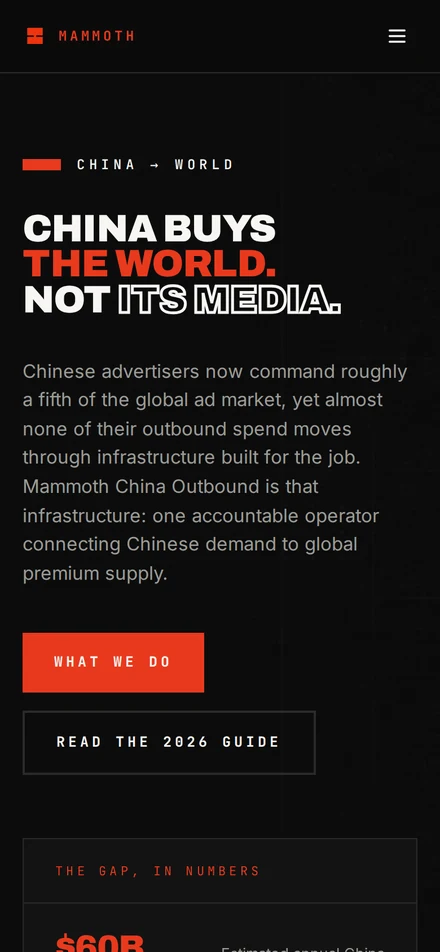
The homepage leads with an assertion rather than a description — China buys the world, not its media — set in heavy condensed type against near-black, with a single signal red. An investor should understand the thesis before scrolling. Beside it sits the gap stated in three numbers: roughly $60B in annual China outbound advertising spend, a 20% share of the global ad market that exceeds China's share of global GDP, and nine of the world's top twenty-five ad sellers being Chinese companies.
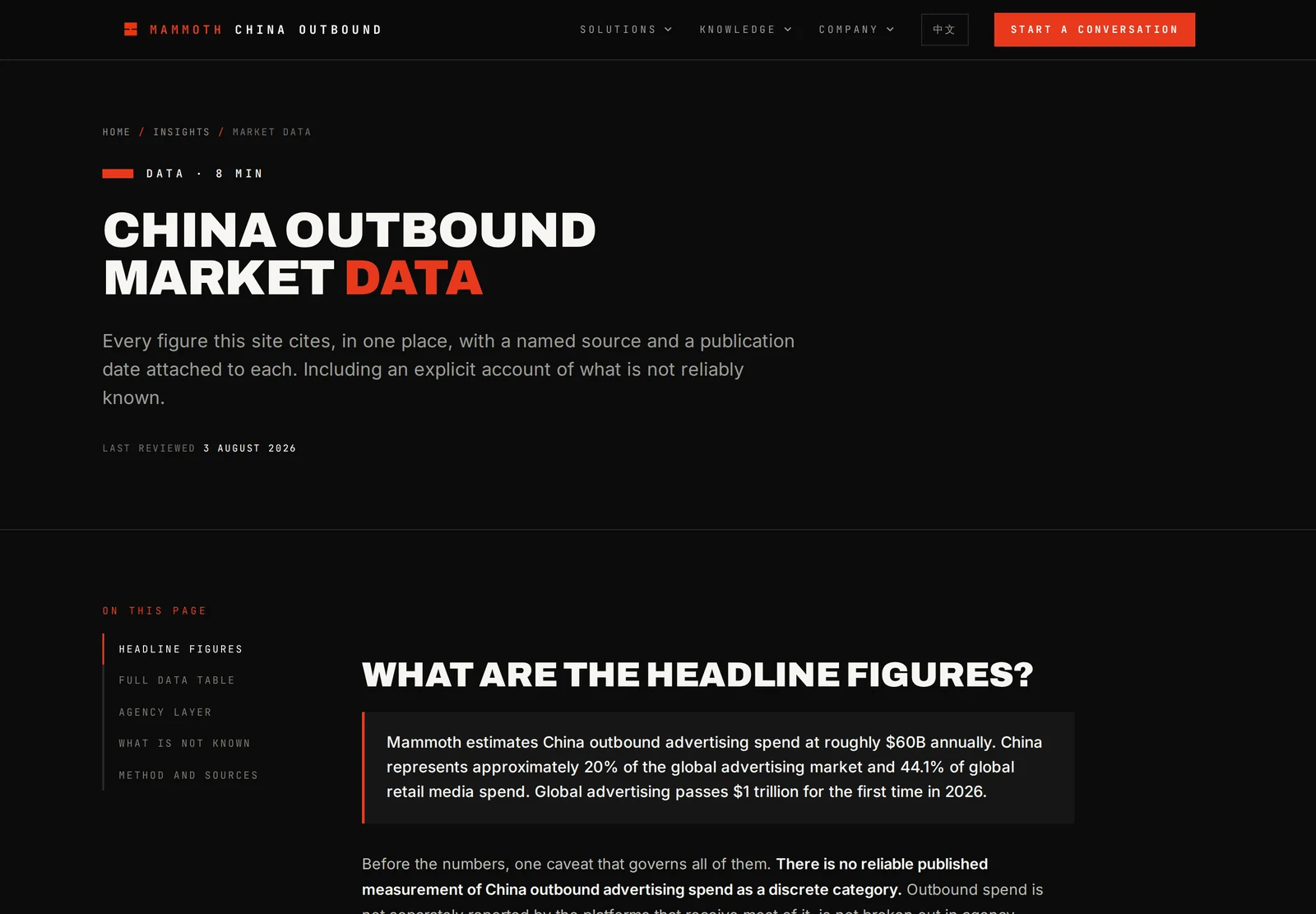
Every one of those figures carries its source inline — the ResearchAndMarkets China Digital Ad Spend Databook, WPP Media via Axios, a Reuters investigation into China-origin ad fraud. There is also a dedicated page where every figure on the site is listed with its citation. That page is the most AEO-native artifact in the build: it is a purpose-made citation surface, and it is the kind of thing a model will quote precisely because the provenance is already attached.
The argument is sequenced so each section earns the next — market, problem, why now, positioning, three-legged proof, business model, economics, the ask — because a thesis broken into bullets loses the causal chain that makes it persuasive. The technology leg rests on ReachMax / AddNewer, China's largest third-party ad-serving platform, with a Mammoth co-founder among its founding members.
Like the wellness build, the entire site runs in English and Chinese. For a venture whose whole premise is a crossing between two markets, a monolingual site would have argued against itself.
- Languages
- English + 简体中文, full parity
- Citation surface
- Dedicated market-data page — every figure, named source, publication date, last-reviewed stamp
- Schema
- Organization · Article · FAQPage · BreadcrumbList
- Long-form asset
- The 2026 China outbound guide
Figures shown are the client's own research and projections as published on their site, each attributed on the client site to a named third-party source.
RelationshipThis engagement came through Jay Faires, Founder and CEO of The Wellness Agency and a founding partner in Mammoth China Outbound. The Wellness Agency is a separate AIGNCI client with its own case study on this site. Gordan Domlija has no involvement with The Wellness Agency.
Continue throughthe evidence.
Tell us what you are building.
If the question is about discovery, reputation, a new site, or a market move, send the context. AIGNCI will tell you whether an Audit, a build, or a more focused engagement is the right starting point.